Magic City Mayhem
An overworked necromancer struggles to hold back the tide of magical chaos engulfing Miami
Coming June 2026
Click to read a sample!

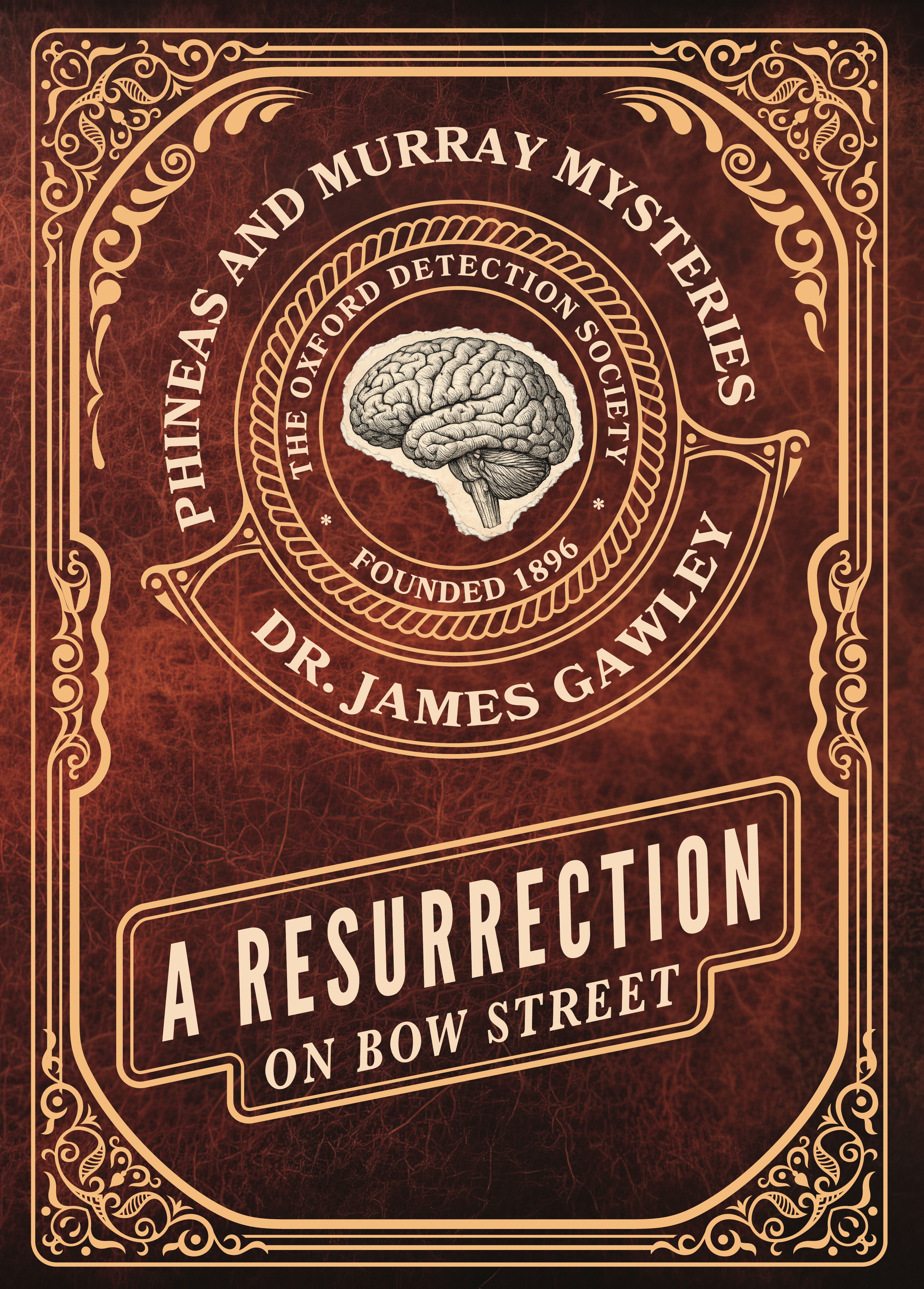
Chapter One: The Madman
London, 1896
When I first met Inspector General Murray he was confined to a room in the Morhaim Sanatorium for the Criminally Insane. The reader will no doubt know Inspector Murray as the father of modern criminal science, the man who organized the famous card-catalogue of felons that today forms the beating heart of Scotland Yard, the man from whose fertile mind sprouted the Standard Witness Questionnaire, the man who developed the classification of born criminals, insane criminals, and criminals of circumstance, indeed the very same Inspector Murray who first began the comparative study of fingerprints. And if you do not know of Inspector Murray’s contributions to science–for I am forced to admit that in today’s bustling and indifferent world this may be the case–nevertheless you surely have read articles about the peace officer who suddenly, and for no reason that he could name, shoved an old man leaning on cane off of Paddington Sixth Platform and into the path of an arriving locomotive where he was slowly but inexorably crushed. For there is little that a newspaper-man likes to write about better than the grisly death of an innocent, and if there is, then that is the story of lofty authority brought shamefully low, and in the case of Inspector Murray there could scarcely be a drop more precipitous than that from the very height of civil authority to the locked cell of an insane asylum.
I will take it, then, that you are familiar with the man.
As for the nature and condition of his cell, I can report it reliably from my notes: it was a tower room in a dilapidated country mansion whose high surrounding walls and ample grounds had recommended it to the Oxford Medical College as a suitable locus for the confinement and study of insane criminals–a classification that, you will recall, Inspector Murray had himself first developed and proved. Owing to his importance to both the Medical College and the Yard, to say nothing of his status as a gentleman, Inspector Murray was kept in the highest degree of comfort that could be expected. His tower room measured ten paces by ten, and at the time of my visit, some six months after his first confinement, it already contained two large glass-fronted bookcases, a four-poster bed, a small writing-desk, a cedar water-closet for performing the inspector’s necessaries, a wash basin, and an ewer of water. The room’s octagonal walls were pierced by three octagonal windows looking out on the east, south, and west grounds, all reminiscent in size and shape to a porthole in the cabin of a steamship. Through the east window, when I arrived, the smokestacks of West London obscured the setting sun. It was five o’clock in the post meridian on a damp and blustery December the twenty-first.
Inspector Murray was a slight man, with bright black eyes set deeply in his skull above dark pouches like smears of ash. (I would later discover that Inspector Murray rarely slept, though his lips never let past a drop of either coffee or tea–he was a strict teetotaler, too–but sat up late each night, analyzing the day’s observations of his busy mind, drifting off in his chair for a grudging three or four hours of oblivion, before waking to some sudden revelation and devouring the day. The four-poster bed in his tower room was covered in a thin layer of dust.) Inspector Murray’s hair was brown, receded sharply at the temples, and combed back and side-ways on his head. His ears were large, with detached lobes, his nose was aquiline, his beard neatly trimmed in the style made famous in an earlier age by Anthony Van Dyke. He was seated at his writing desk as I entered, admitted by the attending physician of the institution, the alienist Dr. Richard Spelton, who was as beefy and red-faced as Inspector Murray was bird-like and thin.
Dr. Spelton moved to the writing desk where Inspector Murray sat erect in his seat. “Inspector Murray, I hope you are feeling well this evening? Allow me to introduce Phineas Alexander, lately the president of the Royal Society.” The doctor took his patient’s pulse at the wrist as he spoke, gesturing toward the doorway and toward me with a tip of his head. This was Dr. Spelton’s manner of introduction. I thought I detected a slight emphasis on the word lately, and I stared at Spelton until he lowered his eyes and wiped the superior smile off of his thin-lipped mouth.
Inspector Murray, for his part, watched me with unblinking eyes.
“Yes, how do you do, Inspector? No, don’t get up,” I said as I struggled to fit through the doorway with the many cases of my apparatus gripped in my hands and trapped beneath my arms. Neither the doctor nor the inspector showed any inclination to come and help me. I have often found that it is the case with men who make a living with their minds alone that they will not rise to aid with the burden even of a fellow man of science, when he works with his hands; whether this is because they conserve their energies for more abstract pursuits or because their mothers did not teach them better manners, I have not determined. The inspector watched me sweat as I carefully lowered my various cassettes, receptacles, and canisters to the floor, and I spoke cheerfully to put him at his ease. “I was delighted to receive your letter, for, do you see, I have just recently wondered, as you are wondering, whether the organic changes that cause madness might be detected in a living person and not merely exposed post mortem through dissection of a cadaver, as in Dr. Broca’s lectures – I believe I have seen you in the surgical theater, inspector? So we know that madness or even criminality might be caused by organic changes, but might these changes be detected by means of noninvasive instruments? That is a most worthy question. And here you are, the perfect subject for a scientific inquiry, and of course I have you all to myself for just as long as I like. Well, this is a fairly charming room, under the circumstances.”
Spelton had completed his examination of Inspector Murray’s glands, tongue, and heartbeat–this last inspection effected with the aid of a tubular phonendoscope of my own design, which you will now find in hospitals around the world. A trivial instrument, it joins together the faintest echoes by means of a cup and tube pressed to the torso, with the result that a physician may eavesdrop on biological processes inside the body. I have often found that the simplest and easiest inventions are the most universally adopted, and a man may strain for years in dogged pursuit of a goal only to realize, upon his retirement or god forbid his deathbed, that his greatest contribution was a set of notes he scribbled one afternoon during lunch or a listening device he knocked together as a stepping-stone on the way to something ‘greater.’
As I contemplated this curious fact of life, the alienist Spelton interviewed his patient with a series of questions designed, I can only imagine, to expose whatever madness had possessed Inspector Murray beside the train tracks through bald impertinence and the sheer tedium of repetition. What was the patient’s name, age, occupation, and residence? How many sexual partners had he had, and were they male or female? Did he know where he was, and what brought him there? Did he believe himself wronged or cheated? Were his parents truly his parents? Had he been especially condemned or elevated by God? What was his name, age, occupation, and residence again, please?
Inspector Murray answered these questions with a fair display of tolerance, emitting only the occasional sigh and giving Spelton a cool look when he repeated himself. I believe that in his place I might have had a few choice words for Dr. Spelton regarding his manners and breeding, if I had been thus interrogated every day during six months of confinement in a tower room.
By this time my instruments were stacked in good order, still inside their containers, and I had recovered from the sticky and breathless climb. So I led myself on a tour of the tower chamber, hands clasped behind my back so that the inspector, whose eyes followed me around the space with a policeman’s squint, would know that I had no ideas of disturbing his property. The room’s four-poster bed was equipped with a canopy and heavy purple curtains in an old-fashioned style. The armchair and ottoman were richly upholstered, and a pipe and tobacco-box sat on a marble-topped end table beside it. The carved wooden desk and chair that the inspector occupied looked well-used, as did a massive chest of tiny drawers along one wall. But the room’s true fascination was its glass-fronted cabinets.
What I had first taken for bookshelfs proved instead to be a kind of display case of the oddest collection I had ever seen. I cannot recall the contents of all these shelves, but I can attest that each item was attended by a folded card labelled in an elegant hand. For example, I saw a human liver floating in a green glass jar accompanied by a card that read, “April 27th, 1891. Man’s hobnail liver, weighing three pounds. Case No. 0103.” I do not swear to either the date or the case number, of course; I only submit it as an example of the organized mind on display – for, do you see, the large wooden card-file contained index cards with the salient details of each case, and these case numbers were cross-indexed in three great folios according to the type of crime, instruments or means of execution, neighborhood where perpetrated, et cetera, in a veritable concordance of iniquity. Although the cards catalogued burglaries, assaults, and rapes as well as the descriptions, addresses, and known associates of convicted criminals, the glass cabinet was reserved for evidence related to incidents of murder.
All of these details I was to discover later; on that first evening in Inspector Murray’s tower, I saw only the pieces he had chosen to display. Among the cabinet’s grisly trophies I can recall with certainty a blood-stained knife mounted on a copper stand, the plaster cast of a foot, a petri dish of yellow crystals, a Valentine’s meat juice bottle, a lock of blonde hair, and a single piece of fly-paper scraped clean of its paste.
“Have you brought the x-ray device?” The voice of Inspector Murray woke me from my reverie.
Evening had fallen. Dr. Spelton had completed his interview and taken his leave; I vaguely recalled murmuring a farewell to him as I examined Inspector Murray’s outlandish collection of murder trophies, for I had realized by now that this is what they were. Imagine taking the time to mount such a collection – and then placing it directly across from the bed where you sleep! I am no student of the human condition, but even I could see that Alexander Murray was a lifelong bachelor. “The x-ray device. Erm, yes, I have a rather ingenious revision of Edison’s cryptoscope here in this box. However, I believe we must begin with more basic tests.”
At these words from me, Inspector Murray gave a very tired, threadbare sigh. I opened a cardboard suitcase packed with cotton and withdrew a fundus mirror and a sphygmograph à la Alexander for recording fluctuations of the blood. “Not to worry,” I told the inspector. “This will be no alienist’s aimless interview.”
I will confide to you that I really cannot abide an alienist; they are not properly men of science, for all that their intentions are good. Do you know, for example, what the Manual of Psychological Medicine lists as the conditions predisposing a person to insanity? The Climate, the Phases of the Moon, Life in the Country, Life in the City, Conditions of Poverty, Conditions of Wealth, Intense Study, Idleness, Amorous Excitement, Repression of the Reproductive Instinct, Civilization, and Marriage. In short, the whole sorry crew of humanity is predisposed to go insane, except for the alienists, who have yet to restore a lunatic to sanity in the long, sad history of their asylums. Therefore I aimed to reassure the inspector when I told him, “We will confine ourselves strictly to the realm of the physical.”
At this, Inspector Murray fixed me with a most grim stare. “I insist that we do.”
I took this to be a reference, not to alienism, but to my humiliating dismissal from the Royal Society, as whose president I had served for nearly ten years. This is a subject I do not care to dwell on, then or now. Therefore it took me some time to master my anger and I covered my emotion by taking my time to unfold the screens and lenses of the fundus mirror and to light a whale-oil lamp. “Bring your seat closer to the armchair, please.”
As Inspector Murray positioned himself, I situated the end table between us. Upon this table I positioned the lamp and arranged Inspector Murray’s forearm palm-up on the marble surface. I then set up the apparatus of my electrosphygmograph. This is a rather sophisticated invention, and I will give only the most cursory description; anyone curious may apply to the patent office for a complete schematic.
A plate of quartz crystal the size of a shilling is pressed to the wrist, backed by insulated plates and held in place with straps against the radial artery. A brief electric current is produced by the subject’s pulse against this quartz plate, and this change in current is measured using a Kelvin’s electrometer. This is a large brass cylinder containing a suspended metal plate attached to a mirror. As the electrical current changes, the plate is drawn toward one side or another of the electrometer, bringing the mirror with it. The light reflected from this mirror is recorded on a roll of photographic paper that unwinds on a clockwork drum outside the brass chamber. This combined instrument is a device of which I am, I think, justifiably proud. Its extreme sensitivity not only records the rate and sharpness of the pulse, but accurately records changes in arterial pressure from one heartbeat to the next. Sadly, it is much too cumbersome, costly, and delicate for ordinary medical use.
With the photographic paper steadily unwinding, I took the armchair opposite the inspector. Beckoning him to lean toward me, I shone the fundus mirror into his eye. The mirror reflected the lamplight onto the retinal membrane, I peered through an aperture in the mirror, and the inspector’s aqueous humour disappeared, revealing the pulsating vessels of his inner eye. I took my time about the inspection, shifting my perspective left and right, examining both eyes twice. I made a show of consulting the jumping light of the electrical sphygmograph. At last I sat back in my chair. “Your arterial pressure appears to be normal, sir. There is no swelling of your optic disc.”
I did not elaborate, but forced the inspector to inquire: “What is the significance of this finding?”
I folded the fundus mirror slowly and returned it to its case. “We are here to determine whether your… sudden lapse in conduct might have stemmed from organic changes in your brain.” The inspector nodded. “This result suggests that it does not. If there were a lesion or a tumour crowding your brains, then there would be greater pressure inside your skull. That pressure would distort the optic disc. Instead, your arterial and intracranial pressure are quite nominal.”
“You have not examined my skull with x-rays.” The inspector gazed at me quite fixedly, and I sighed.
I could see that Inspector Murray was desperate. After all, if he had a brain tumour, it might be removed. If he had simply suffered a mental breakdown, well, then he would not be released until Dr. Spelton cured him. Since no act of psychiatry has ever yet cured a murderer, this must have seemed to the inspector a very grim prospect. I pushed myself up from the armchair and retrieved my cryptograph.
The cryptograph is a kind of portable flouroscope: a visor is strapped over the examiner’s eyes, trimmed in fox fur to block out the light. This visor is narrow at the eyepiece and widens outward, until about ten inches from the face it ends in a screen coated with calcium, which entirely fills the operator’s vision. A vacuum tube is placed on the far side of the patient – specifically, an Alexander’s tube, whose design resulted in my appointment to the Royal Society so long ago – and an electrical current is run through the tube. Rötgen’s x-rays are emitted from the tube, pass through the patient, and strike the screen. These rays cause the calcium to flouresce, or glow. The effect is faint, thus my arrival in the evening, with just enough time to set up my instruments in daylight before nightfall rendered them usable.
I dutifully set up the cryptograph and examined Inspector Murray’s skull for signs of lesion, of osseous excrescence. I turned the patient’s head to the left and right. I tilted him up and down. I moved the vacuum tube, replaced the acid in my galvanic pile to renew its electricity, and made thoughtful noises so that the inspector would know he was being thoroughly examined. Only after I had twice exhausted the galvanic battery did I pull the visor off of my head and twist the gas lamps on the walls open to their fullest flame. Exhausted as I was, I began to careful repackage my instruments. I was not looking forward to spending another hour in that room.
“Well? Do not be dilatory. What did you find, sir?”
“I found nothing, sir.”
“You must look again.” The inspector’s tone was peremptory; this was a man accustomed to being obeyed.
I forgave him the rudeness, but I wanted to be clear with him: “You do not have a brain injury, sir. Your actions cannot be explained that way.”
Grief and desperation twisted the inspector’s unassuming face. “You are mistaken.”
“I am not.”
He shook a fist at me. “I am not a murderer!”
I could only look at him. You are, sir. I abstained from forming the thought aloud.
When I would not engage with him, Murray sagged back in his chair with a creak. He put his face in his hands to cover his tears. “I should have known better than to trust you. I put my faith in a fraud.”
“I beg your pardon? You are speaking into your hand, sir. Perhaps you would like to lower them and repeat yourself.”
He dropped his hands. “I say you are a fraud, sir! Your former colleagues exposed your incompetence, and now you prey upon me with your foolish hand gestures and your silly hems and haws.” He waved his hands in imitation of the thoughtful motions I had made in examining him, gestures designed to comfort him in his fear.
I could not have been more insulted if he had defamed my mother. I stood over Murray now, very close to his chair.
He craned his neck to look up at me. “Yes, I know you are disgraced. I know about The Phenomena of Spiritualism. I know you believe in ghosts and in unseen forces. Better I had never written to you. Lunacy.” This last he muttered in the direction of the wall.
With an effort, I preserved my calm. “Magnetism is an unseen force. Galvanism is an unseen force. Radiance, x-rays, these are unseen forces. I’ve just used them to peer inside your skull. I’m using them right now to measure your blood flow.”
Murray laughed a widow’s heartbroken chuckle. “And you use them to chase after ghosts.” He stared at me with red, wet eyes, and did not get out of his chair.
After a long moment in which I wondered whether I could demand satisfaction from a man confined to a lunatic asylum, I moved to the window. The stars were visible near the zenith, but obscured by the smoke from London’s stacks closer to the horizon. The wooden grid of muntins between the window panes had been repainted by a clumsy hand some years ago. Streaks of blue had not been fully scraped from the glass. I saw again the auditorium of the Royal Society, heard once more the learned voices ridiculing my efforts. How could men who believe in God not believe in the soul? And believing in that intangible essence, why not search for it with the new means at our disposal? I had tried to unite the scientific and the spiritual, and been humiliated. “Why did you write me?” I asked of Murray’s reflection.
“I wrote to dozens of men. Natural philosophers, doctors, physicists. Friends. You were the only one who answered.”
I turned and faced him. He was such a small man, and so obviously frightened. When I considered my anger, my desire to strike him just moments before, I was ashamed. “How many have visited you, since your incarceration?”
He shook his head. “Only you.”
“Well.” I began to free his wrist from the electrosphygnometer’s cuff. “I could visit again, if you like.” He glanced up at me and I gave him half a smile. “It seems you and I have something in common.”
His eyebrows furrowed, just a little. “What is that?”
“No one will return our letters.”
He gave a sad little snort that might have passed for amusement. I laid the piezoelectric cuff on the table and fetched the case for the electrometer while Inspector Murray rubbed his wrist. When I returned to the brass instrument, I frowned. “Are you kicking my instrument, sir?” I peered at the base of the brass cylinder, but the inspector’s feet were nowhere near it. Nor was he touching the quartz pressure pad. Yet the circle of light thrown by the mirror was leaping wildly up and down the photographic paper.
“Is there something wrong with it?” Inspector Murray could clearly see that the device was behaving oddly.
“This is a laboratory instrument,” I berated myself. “I should never have brought it up here. Oh, oh, oh!” I picked up the wrist cuff, as distressed as a mother bird whose chick has fallen from the nest. The motion of the light stopped immediately. I frowned.
“Why has it stopped?” Inspector Murray asked.
“It is supposed to stop. The question is, why did it start?” I tapped the quartz pad with a fingertip. The circle of light bounced once, much higher than it had when measuring the inspector’s pulse. Just as it should have done.
I rewound the spring that drove the photographic roll, scratched a note on the paper marking the change in measurement, and sat in the armchair. With the cuff around my wrist, I could watch the excited thumping of my own heart upon the slowly unwinding paper. “Let me see your wrist, please.”
I marked the change in ink upon the paper roll and replaced the sensor on the inspector’s wrist, this time with the paper still unwinding. Once the cuff was in place, the light traced out the familiar double-peak of a normal heartbeat. But as the cuff approached the inspector’s skin, I saw something peculiar: the light flew to the top of the roll and stayed there, wobbling against the top of the page. When I drew the sensor away from Inspector Murray, the light subsided. “This is fascinating.”
“Is it broken?”
“No! I don’t believe it is.” I brought the sensor close to his body, slowly tracing the field of the effect, laughing like a schoolboy. Quartz is piezoelectric, you see; it produces a faint electric current when it is compressed, as for example when the inspector’s heartbeat thumps against. Otherwise it is inert. Yet when I passed the sensor through the air near the inspector’s body, the quartz compressed of its own accord, sending an electrical pulse to the Kelvin’s electrometer. “Unseen forces, indeed. Inspector Murray, I believe you are being visited upon.”
“What exactly are you talking about? I will not hear any talk of ghosts, I warn you.” Inspector Murray’s voice was peevish. I surmised that he had expected me to leave him to contemplate his fate, and now resented my ongoing presence. I did not much care. I laughed again.
“My dear inspector, do not be cross with me! For I know now why I am here today. Providence has sent me to be the instrument of your salvation. And you, Inspector Murray, you will be the instrument of mine.”
An overworked necromancer struggles to hold back the tide of magical chaos engulfing Miami
Coming June 2026
Click to read a sample!
Democracy teeters on the edge of a cliff. Two men who would be king vie with each other to deliver the final push.
Coming September 2026
Click to read a sample!

The Doomships have wandered the stars for centuries, their guns silent, until a conspiracy threatens to wipe them out–and half the galaxy with them.
Click to read a sample!
A disgraced scientist teams up with an criminally insane detective to stop a paranormal evil in Victorian London
Click to read a sample!

Bess has run away from her home and family to become a pirate, but she can't outrun her past.
Sample coming soon.