
Magic City Mayhem
An overworked necromancer struggles to hold back the tide of magical chaos engulfing Miami
Coming June 2026
Click to read a sample!

Chapter 1: Jobs Aplenty
I wish I was the wizard that arrives precisely when he means to. My clients deserve punctuality, since I allow them to speak to the dead one last time. But Miami is a death sentence for timeliness.
Dade South Memorial Park consists of three cemeteries abutting each other, sandwiched between the Turnpike and a residential neighborhood. Jimenez Peña Dade South is the largest of the three. A yellow stone wall topped with iron spikes surrounds the property on three sides. Chain link fence separates the cemetery from the Turnpike and provides commuters with a glimpse of the inevitable.
An archway stands at the entrance, bearing a tile mosaic of the Archangel Uriel at its zenith. St. Uriel wears gray robes, holds scales in his left hand, and a lantern holding the sun in his right. He is only mentioned in apocryphal writings, which sometimes rubs Catholics the wrong way, but the choice has always seemed obvious to me--the Archangel of Death guarding a cemetery.
Late as usual, I feel judged as I pass under the archway. The burial is at eleven. A post-mortem interview usually doesn’t take more than an hour but I know I’m going to have to deal with Benito Jimenez, the director. My tardiness gives him another excuse to think he is better than me.
Opulent royal palms shade the central boulevard leading to the management office. Live oaks line the rest of the cemetery’s thoroughfares, their sprawling canopies proving more affordable for the management and more capable of protecting the headstones and their visitors from the unforgiving sun.
A single-story building made of the same yellow stone as the perimeter wall serves as the management office and hoards the only parking lot on the premises. Visitors don’t even bother with the lot, since the private road throughout the cemetery is wide enough to allow for parking.
I use the lot. There are only four other cars there. I park my run-down Civic between Jimenez’s BMW and the groundskeeper’s rusty pick-up.
I tug open the pane of glass that serves as a door. Large windows light the cramped office, turning the bone-white tiles and walls yellow. Six cushioned chairs crowd against the wall across from the open receptionist’s sliding-glass window, making the place feel like a doctor’s office.
Maggy peeps above the counter and smiles when she sees me. She’s a large woman, well-tanned, in that indistinguishable post-menopausal-but-not-yet-gray age, and she’s sweet on me. “Buenos días, Doctor Díaz,” (Good morning, Doctor Diaz) she says.
“Good morning,” I say back in Spanish. I lean in through the window and give her a kiss on the cheek. If I didn’t, she would be offended.
“Cafecito?” (Coffee?) She holds up a tiny Styrofoam cup with a plastic cap. Let me be frank: I play with magic, with the unthinkable; I have pushed my hands through the ether and wiped away the essence of life and death itself; but what Maggy offers me is the most powerful concoction I have encountered. Cuban coffee is just espresso, but the foam is four tablespoons of sugar. I know how to make it, but I never have time in the mornings. The whole of Miami runs on Cuban coffee. If you ever want to decimate South Florida’s productivity, just bomb the Bustelo plant.
Maggy makes the offer, even though she sees me carrying a thirty-ounce cup of iced coffee. She proffers a thimble-sized plastic cup out of genetic habit. I take it. “Thank you,” I say.
“You’re welcome, papi. You’re late again.”
I smile and throw back the shot. “Are they in there?”
“Talking. You’re okay.”
I take sweet relief from her beautiful, chubby face. “How many?”
“Just the widow.”
They come in expecting a lot, and Jimenez is the front man who lets them down, grounds them, making sure they know the rules. It isn’t a miracle I’m working; it’s just accessing memories. They’re not going to speak to the deceased, just to the storage system for memory. Information can be accessed, yes or no questions can be answered, but emotions, closure? Those things are usually beyond my reach.
“What are you reading?” I ask.
“The Russians are at it again.” She sucks her teeth and flips El Nuevo Herald around to face me.
Spanish was my first language, the language of my immigrant parents, but I stopped reading it after high school. I struggle with the headlines, but the picture of a police boat loaded with black body bags speaks louder than words.
Maggy taps the picture. “The bodies were missing their tongues, hands, and teeth! ¡Que salvajada!” (What savagery!)
Whoever did that was smart. They must know what I can do with a dead body.
Jimenez pokes his head out of the back office and grimaces. “Practitioner Diaz, would you mind joining us?” When he asks me into the room in English, I know what language to speak when I get inside.
The honorifics of being a wizard are tricky. Officially, I have a doctorate, so on paper I am Doctor Pablo Diaz. I serve as the Necromancy Department Head at the College of Practical Arts, so among wizards and other magical creatures my title is Archmagus. But practicality--that loathsome place between the officious and the magical--came up with the title ‘practitioner’ to imply someone who works with magic, an annoying catchall meant to pigeonhole me. Jimenez only ever uses the honorific when he is upset. I swallow this insult.
I chug the rest of the coffee and start looking for a garbage can. Maggy motions for the cup. “Thank you,” I say.
“A la orden, mi corazón,” (At your service, my heart) she says.
My breathing becomes choppy. My pulse quickens. I wring my hands. I have done what I am about to do hundreds of times. But the nerves always jump. The opportunity to do what we love, even when we have done it countless times—the simultaneously novel and mundane nature of performance—may be at the heart of all human achievement.
I bump my leather doctor’s bag against my leg as I walk to the back room, the largest area in the office. It used to be Jimenez’s personal work space, but since it was the only space large enough to comfortably sit a family, he had to give it up. I believe he holds it against me.
Armless wooden chairs dominate the walls. Black-out curtains stymie all but one of the windows.The floor is empty, save for a casket. Jimenez and the bereaved flank the casket, but he stands while she sits.
“Good morning, Mr. Jimenez,” I say.
“Good morning,” he says, hands folded in front of him. Jimenez has always played the role of the mortician well. I can’t imagine there’s more than a foot of space between his bald head and the ceiling. He has dark bags under his eyes, a wide forehead, gaunt cheeks, and a pencil thin mustache. The latino Lurch. He looks down his nose at me and motions to the other person in the room. “Mrs. Maria Batista, this is Practitioner Pablo Diaz.”
“I am sorry for your loss.” I extend a hand to her.
The Widow Batista takes it. “Thank you.” Behind a black veil, I can see the wrinkles radiating from her lips—a smoker. Otherwise, her skin is still taut. Her lips are well-rouged. The sharpness of the suit she wears fails to occlude the smudges of mascara under her eyes. “René was a good man,” she says.
She turns in her seat and lays a hand on the coffin behind her. The belly of the man inside of it rises above the lip of the casket. His jowls reach below his collar, his neck threatening to devour his chest. His hands are folded awkwardly over his stomach. Even in death, this man’s body seems to find no comfort.
“This is not an easy procedure, Mrs. Batista. Are you sure you want to go through with it?” This is a lie. For me, it couldn’t be easier. But hearing the voice of a deceased loved one is a volley of rocks against the glass of our souls.
She nods, so I begin to set up. “Remember, yes or no questions are easier, and don’t be frightened. There is no soul in the body. Only motion.” I jut my chin toward the curtain and Jimenez closes the remaining open window. I open my doctor’s bag and pull out my occult accoutrements: a black silk pall, a candle made from the rendered fat of a yearling calf, an earthenware jar full of coarse sea salt. I drape the body. I light the candle at the head of the casket and wait for Jimenez to turn off the lights. I pour salt from the jar over the corpse. I speak a few syllables unfit to reiterate. There is a hiss as the salt drags itself over the silk, taking the same pattern as veins. The granules begin to glow blue. I take a pinch under my tongue and place a hand on the deceased’s forehead.
“You may ask your questions, Ms. Batista,” I say.
She might be on the verge of sobbing. “René?”
The salt burns and dissolves. “The questions, please,” I say, trying my best to keep my voice level.
“Did you love me, René?” Mrs. Batista says. Nine times out of ten, this is the first question my clients ask. They might word it differently--Did we live a good life together? Was our marriage worth the pain?--but the sentiment is the same.
Under the pall, the muscles of the jaw creak and pop. “Yes.” Barely a whisper, but unmistakable.
She sobs. “Did you cheat on me?”
“Yes.” The words are René Batista’s, but the life in the corpse is my own. The salt veins pulse to my heartbeat. I am sweating. Hot wax drips down my fingers.
“With who?”
“Margaret, Estrella, Lourdes…” The corpse rattles off a litany of indiscretions, robbing René Batista of the dignity death might have ensured. The corpse finishes its catalogue with, “And whores.”
Maria Batista covers her mouth, trying to muffle her sobs.
I keep my mouth open as the salt sublimes. The wisps of white smoke dissipate quickly. The same happens on the corpse. I grab another handful from the jar and let it slide through my fingers onto the pall, then throw another pinch in my mouth.
“Mrs. Batista,” I say, “please continue.”
She gathers herself up. “Why cheat, René?”
“They did what I wanted,” the corpse says.
Maria Batista jumps up and slaps the lip of the coffin. “Don’t I mean anything to you?”
“You’re my wife.” Rene’s thoughts distilled into inscrutable simplicity, sure to provide no comfort.
I watch her hands grip the edge of the casket. She stands a little taller. “That’s enough,” she says.
“Are you sure?” The ember in my mouth is horrific, but this is my job. Satisfaction guaranteed.
Maria Batista frowns. She glares at what was once her husband. “What happened to Bati?”
“I broke its neck.”
She thumps on the casket. “I knew it!” She rests her chin against her own chest with a sigh. “You can stop,” she says to me.
I snuff the candle with my fingers. The salt on the body goes up in a large puff while the salt in my mouth fizzles. I flick the lights back on. “Water, please.” Jimenez goes out. “Mrs. Batista, I have to ask who Bati is, because if I have learned of a crime, I have to report it to the authorities. You understand.”
“Bati was my parrot twenty years ago. No crime, except the ones against me. And it is Ms. Batista. Thank you very much, Practitioner Diaz. Pablo.” She walks away.
Jimenez returns and hands me a water bottle. I chug the entire thing. He tries to talk to me, but I can’t hear him. “What?” I say.
“Are you okay?”
“I’m fine. Do I not look okay?” I retrieve some hand sanitizer from my bag and apply it liberally.
Jimenez purses his lips. “A bit pale,” he says.
“I don’t get to the beach a lot.” I begin gathering the magical paraphernalia.
Jimenez watches me from the doorway. “Such frivolous questions.”
“Tell her that when she signs the check.”
“She already has. I’m sure you’ll want your cut, as well. Follow me.” He doesn’t wait to see if I follow.
I join him in his putrid green office. Black and white photographs in ostentatious gold frames hang on the left and right walls, showing the groundbreaking of the cemetery and Jimenez’s ancestors. Jimenez sits at his formidable credenza writing out a check from a tome-sized ledger. Behind him, an austere display case filled with sample urns partially blocks the window on the back wall.
The charge is $5,000 for a post-mortem interview. After taxes, Jimenez takes fifteen-percent, leaving me with less than $3,000. “I will never understand you, practitioner,” Jimenez says. “You could easily ask for double and people would still pay.”
“My fellow necromancers and I decide on a fair price each year.” There are only eight of us working in the city, and we rotate post-mortem interviews for extra income. We all agree the price is too high, but the cost of living in Miami is astronomical, and only one out of ten funerals requests the ritual. “Asking for any more would be predatory.”
Jimenez narrows his eyes, but then leans back in his chair. “I only bring it up because that jacket is looking thin at the elbows.”
“This used to be a free service,” I say.
“I know, and then you came along,” he says. He rips out the check and holds it out to me. “Do you know the difference between you and I?”
I can still be classified as a mammal? “Tell me,” I say instead and grab the check.
Jimenez doesn’t release it. “I know what my expertise is worth. This is a business. These people would give us absolutely nothing if we didn’t take it.” He lets go of the check and straightens the front of his jacket. “You peddle a fantasy, but all you cause is pain. And you are never on time.”
The word ‘pain’ conjures Maria Batista’s face when the corpse of her husband listed off his dalliances. “I didn’t change the world, Mr. Jimenez.”
“No, but you aren’t making it better, either.”
I purse my lips and stare at him. “Did you know that curses fall under the purview of necromancy?” I wait until he looks away. Only then do I fold the check in half and stow it in my breast pocket. “I will be conducting the senior-level Necromancy Laboratory on the grounds this evening.”
“I am well aware,” Jimenez says. He keeps his eyes down.
“My students and l will be sure to maintain the sanctity of your grounds through proper warding. Something, I think, that your customers appreciate.” My cell phone chimes in my pocket. “Is there anything else?”
“No,” he says.
“I apologize for my tardiness. It won’t happen again,” I say, certain of the lie I’ve spoken. I pick up my doctor’s bag and leave.
***
There’s nothing anyone can do about traffic in Miami. From sunrise to sunset, the streets are packed with the inconsiderate and hostile masses trying to force their way into your lane and then slowing down as soon as they get there. No amount of magic can influence them, and what should be a twenty minute drive takes me over an hour.
Tucked away behind a local bar and a cigar shop in South Miami is Smoke and Lace, a gentlemen’s club. I’ve never seen gentlemen inside the club. But I haven’t seen police tape outside the entrance before, either.
The text I got earlier was from Sergeant Sean Richards. I try to pull into the parking lot, but a deputy stops me. He radios Richards then waves me through. I bring my doctor’s bag with me, because Richards only calls me for one reason.
The metal door to the bar is open. I have to explain who I am to another officer. Usually this place is a smoky neon hole. Even at 11a.m., it still reeks of stale beer and cigarettes, but the fluorescent lights are on, and there is nary a stripper to be found.
“Diaz!” Richards calls to me from across the main stage—a two-foot high platform with brass poles at each end, flanked by two levels of small tables and large armchairs. He’s wearing a suit, not a uniform. He’s tall and white and steely-eyed and tired, but his posture towards me is always friendly; I make his life easy. He extends a hand as I approach. “Always good to see you, Practitioner.” He uses the title because I’ve never corrected him.
“Good morning, Sergeant. Give me the rundown, please.”
“Not much to tell, really,” he says as he leads me to the back of the club. “Around closing time, there’s a gunshot in the bathroom. The place clears out. No one saw the shooter—probably got away in the stampede.”
“Where’s the bathroom attendant?” You can’t go to a strip club in Miami without a dude in cuffs hawking wares—gum, cologne, single cigarettes.
“He’s the victim.” Richards pushes open the bathroom door. Face down in a pool of blood is a rather skinny black man. He wears good dress pants and shoes, a well-starched white shirt, and a horseshoe of gray hair. “At least he’s already dressed for the funeral. Just need to get him a jacket.”
The blood makes my knees buckle. I lean against the door frame and take a few deep breaths until the nausea goes away.
“Pussy,” Richards says and laughs.
“Listen, I deal with them when they’re cleaned up.”
“Well, you know how these things are. The faster we get a name, the more likely we are to get a conviction.”
“Is Forensics done?”
“Yeah.”
I know how messy this is going to get. “I’ll need someone to turn the body over. And a chair.”
“Sandobal! I need a hand!” A female officer comes in, well-tanned and blonde; she’s also in a suit. “Detective Sandobal, this is Practitioner Pablo Diaz.” We shake hands. Richards and she don latex gloves from a box on the sink and flip the body. Blood plops and squelches as they do so. Dark gore has congealed and caked this poor man’s face.
I put on latex gloves and use a few napkins from next to the sink to wipe as much off his forehead as I can. “A chair, please, detective.” Sandobal runs out and comes back quickly with a black metal folding chair. I set it up at the edge of the pool and try to lean down, but the position is supremely awkward. I sigh. “You’re paying for my dry cleaning,” I say to Richards. I sit at the edge of the pool of blood.
“Just turn in your receipts with a req form to me.”
“No, you know that takes forever. You’re paying, and you turn in the requisition.”
He bunches up his lips. “Fine, fine.”
“My bag, please,” I say. He passes my bag over the body. “Hit the lights.” He does so. “What was this man’s name?” I take out the candle and jar of salt. The pall isn’t necessary, just a courtesy for the bereaved.
“Emmanuel Philippe-Auguste,” he says as he tries to back away from the door frame.
“Not staying?”
“Hell, no. You know I hate this shit.”
“Pussy,” I say and light the candle.
Detective Sandobal moves into the light of the doorway vacated by Richards. She holds up her phone.
“What’s that for?” I say. “Evidence gathered by magic isn’t admissible in court.”
“Not every perp knows that,” she says.
“Have you seen this before?” I ask.
“No.”
“Are you sure you want to?”
“I have to.” She swallows. “Say when.”
I smirk. Maybe Detective Sandobal would like to get a drink. I light the candle, and I know it will be easier to work the spell, because Sandobal is curious, and I want to show off. I throw the salt into the air and speak the syllables. They land in the pattern of veins, glowing blue. I place my hand on Mr. Philippe-Auguste’s forehead. “I need you to put some of the salt in my mouth.”
“What?”
“From this jar.” I motion with my head. She skirts the body, goes around me, and takes a handful from the jar. “Just a pinch,” I say, open my mouth, and stick out my tongue. She sprinkles it onto my tongue, lightly at first. I have to mumble the word “More,” until she gets the idea.
We have such a unique relationship to fat. Chewy, savory, sickening in excess. Similarly, salt can season as well as slay. I don’t actually need the candle made of fat, or the salt, to work my magic. But my mental associations to the items focus my mind and my will, until I am able to do the impossible.
“Did you see who shot you?” I say. I’ve done this enough times that I know the usual questions Richards would want answered.
“No,” the corpse says.
“Who would want to shoot you?”
“Kayleb.”
“Who is Kayleb?”
“My brother.”
“Why would he shoot you?”
“Money. And I tried to sleep with his wife.”
Sandobal jumps to life before I can end the ritual. “Is there anyone else who would want to shoot you?”
“Yuri Orlov,” he says.
“Why?” There is excitement in her voice.
“I was a bagman for him.”
“When?” she says.
Emmanuel Philippe-Auguste gives three dates and exact times. In life, he may not have remembered, but in death, his harddrive of a brain spits out details with perfect recall.
“Detective. More salt,” I say and open my mouth.
Sandobal pockets her phone before squatting down, grabbing my chin, and throwing more than a pinch of salt in my mouth. She steps in Mr. Philippe-Auguste’s blood, but doesn’t notice. Her eager eyes and beaming smile look evil by candlelight. She takes out her phone again and starts recording. “Have you ever met Tamora Orlov or Abram Orlov?” she says.
“No,” says the dead man.
Sandobal sneers. “How did you meet Yuri Orlov?”
“Here at the club.”
“Who introduced you?”
“Jason.”
Sandobal purses her lips. Her voice drops. “Jason Carnero? When?”
“Yes.” And he gives a date, almost eighteen months ago.
“Were you also Carnero’s bagman?”
“Yes.”
Sandobal stops recording. She stands up and yells. “Sergeant!”
I tug at the body’s muscles with my mind, and the body rearranges itself: the eyes close, and the arms move to Mr. Philippe-Auguste’s sides. I blow out the candle. The glowing blue veins of salt mist away. I exhale the same mist out of my mouth.
Richards runs in and turns on the lights. “What the hell happened?” Richards says.
“Detective Sandobal can tell you.” I smile at her, get up, pull off the gloves, and move to the sink to wash my hands.
Sandobal composes herself quickly. “Sir, according to the victim, the perpetrator was either his brother, Kayleb, or get this--Yuri. Orlov.”
“Are you joking?” Richards says.
Sandobal backhands his chest. “No! He’s the bagman! This--”
“What about the brother?” Richards says.
“The victim slept with his brother’s wife,” Sandobal says. “But I don’t think that has anything to do with any of this.”
“I’ll radio this in, see if we can’t have Kayleb picked up,” Richards says. He tries to leave.
“Sergeant,” I say, drying my hands.
Richards is pacing. “What?”
“Don’t forget about my dry cleaning.” There is a line of blood running down the right leg of my pants.
He walks away. I am left with Sandobal. I turn to her. “Would you do me a favor?”
She is staring right into my eyes. “Anything. You just made my case.”
I take my keys out of my pocket and hold them out to her. “There is a duffle bag in my trunk. A silver Honda Civic, parked right outside. Would you get it for me? Also, you stepped in Mr. Philippe-Auguste,” I say and point at her shoes.
Sandobal purses her lips but takes my keys. She cleans her shoe off with a napkin before exiting. I pack up the candle and jar, making sure all my things are free of blood. Sandobal comes back and hands me the duffle. I open it and find a pair of jeans.
“I have a question for you,” she says.
“I need to change.”
“That’s fine.” She crosses her arms and leans against the bathroom wall, staring at the body with a pouty smile.
I go into the largest of the three stalls to change.
Sandobal struggles. “How long have you been a—”
“Practitioner?” I say, and undo my pants.
“Necromancer.”
“Since my mother died.” I put on the jeans and rummage through the duffle for a black plastic garbage bag. “I’ve been working with the police for the last couple of years. Ever seen anything like this?”
“Not exactly.”
I drop the bloodied pants in the trash bag, along with my shoes. “But you’ve seen things, huh?” I pull a pair of sneakers from the duffle and slip them on. There is a water bottle in the duffle; I chug it.
“Yes. When I was a kid. And recently.”
I zip up the duffle and sling it over my shoulder. I grab a card case from my doctor’s bag and take out one of my official cards, the ones with the FIU logo on them that have my title on them. I exit the stall. “Well, if you ever want to talk about it, here’s my card.” I hold it out to her.
She takes it without hesitation. “Doctor Pablo Diaz?” she says.
“That’s me. I didn’t get your first name, though.”
“Elisa.”
I grab my bags, sidle around the body of Mr. Philippe-Auguste, and intentionally brush past her. “A pleasure working for you, Elisa,” I say.
I kick myself all the way to the car. A pleasure working for you, Elisa? Lame as shit. I throw everything into my trunk and my confidence wanes. Who talks to women like that? As I get in my car, a nickelodeon of all the women I have embarrassed myself in front of plays across my mind. I kick on the AC, then kick myself for not getting Sandobal’s number.
Elisa knocks on my window.
I scream like a little girl.
I roll down the window. “Holy shit. You startled me.”
“Everything okay?” She’s giving me a weak smile with a furrowed brow.
“Yeah,”--I sigh--“yeah. Listen, you want to get something to eat?”
She laughs. “Right now?”
“Yes. There’s a nice cafe around the corner. Incredible breakfast.”
She checks her watch. “It’s got to be quick.”
“Perfect.” I get out and lock up my car.
***
Sunset Tavern and Deli Lane share the same building, and the two establishments hide Smoke and Lace from the view of pedestrians. The sidewalk is brick instead of concrete, and the facade of the building is covered in sheets of white limestone to contrast with the black wooden trim. Black iron tables and chairs sit under large green umbrellas. There’s enough of a breeze to sit outside; otherwise, the humidity would make it impossible.
We don’t let the waitress walk away when she brings us menus. She takes our orders at the same time she gets our drinks.
“Now that I’m officially consulting and drawing a paycheck from this case, can I ask you to clue me in as to what is going on?”
Sandobal cocks an eyebrow at me. “You’re getting paid?”
“Of course. You think magic is free?”
“I suppose I did.” She straightens herself up. “Did you see the newspaper this morning?”
“Sort of. Let’s just say I didn’t.”
“Well, we pulled two bodies out of Biscayne Bay--”
“Mutilated.”
“Right. One of them was Jason Carnero, a fixer for the Latin Kings.”
“I thought the bodies were cut up?”
“Not his tattoos,” she says. “I’m pretty sure both men were part of a drug deal gone wrong.”
“For them, maybe.”
“What?”
“It went wrong for them. But it went right for someone.”
Sandobal narrows her eyes at me. “How long have you been consulting?”
“About two years.”
“What made you want to work with us?”
“Bills need to get paid,” I say. “You said you saw something when you were a child. What was it?”
“It’s silly.”
“I promise you it’s not.”
She sighs. “My boyfriend, when I was sixteen, cheated on me. I broke up with him, but I went into a funk. I started seeing something. Something dark. It felt like it was watching me when I was sleeping, or when I was sad.”
“Hmm. Negative emotions can draw all sorts of spirits.”
“What?”
“Oh, yeah. There’s a line in Hamlet. ‘When sorrows come, they come not single spies, but in battalions.’ That’s because there are all sorts of creatures that feed on grief and sadness and hate and they perpetuate the same emotions.”
“Are you telling me it was real?”
“Could have been.”
She thinks it over, and then purses her lips. “My grandmother did a cleansing when I told her. The house smelled like sage for weeks, but things got better.”
“Is she a santera?” Santeria is a syncretic religion. African slaves would worship Christian saints in front of their masters, but each saint was used to symbolize a different god of the Yoruba religion. Miami and the Caribbean is full of its practitioners.
“No, but my mother likes to say she was ‘sympathetic.’” She gives me the air quotes, then runs a hand through her hair.
“Was?”
“She died last year.” She doesn’t look at me when she says this. Did someone perform a post-mortem interview for her?
“I’m sorry.”
“It’s okay. It’s funny, actually. I still feel her all the time. And odd things keep happening in the house.”
“Like what?”
“The clothes she didn’t like me wearing disappear. I always find it under the bed. The same thing happens with the makeup, but only the lipstick that’s too red. She always said that shade was for whores.”
“Jesus.” This woman may actually be haunted.
“Yeah. Abuela did not mince words.” She smiles to herself.
The waitress brings us our food. Elisa ordered an Elena Ruth, which is a turkey sandwich with jelly and cream cheese--diabetes in sandwich form. I guess she has a sweet tooth. “What about you? What made you want to be a…”
“Practitioner.” I smile. “A wizard.”
“It feels weird to say it,” she says through a mouthful.
“I know.” I take a bite of my reuben.
“Well?”
“When I was twelve, my mother died, right out of the blue. Brain aneurysm. My father thought it would help us cope if we did a post-mortem interview. It didn’t. But I watched the practitioner who conducted the interview. I remembered everything he did. And then I did the same thing at home, only without a body. I thought I could summon my mother. Something else showed up instead.”
“What?”
“Wights.”
“What is that?”
“Ghosts that are looking for a way back into the world of the living. They are usually malevolent, and powerful.”
“Holy shit.”
“Yeah.”
“So what happened?”
“Emérico showed up.”
“The Chancellor of the College?”
“Yes. It was after Dead Sunday, only five or six years, and he was still very hands-on. He liked to take care of problems himself, and very publicly. He sensed that something had crossed over and flew to my house and saved me from the wights. He told me to come see him when I was ready. So I did.”
“What’s he like?”
“The Chancellor?”
She nods.
“Well, when I first met him, he was terrifying and amazing, but he was saving my life. And when I learned magic, he was my teacher, and always very excited about it--full of life, really. He mentored me, and passed me the reins of the Necromancy Department so he could get out of the classroom and concentrate on expanding the College. Lately, though, he’s been weird.”
“Really? A talking skeleton is weird?” She is smiling.
“Anyway, I think the job is getting to the Chancellor, is all.” I wipe my mouth with my napkin. “What about you? What made you want to be a cop?”
“Detective.”
I admire her for correcting me. “Right,” I say.
She smirks. “I did start out as a patrolman. We all do.”
“So like I said, why be a cop?”
“I don’t know, really. Seemed right. I’m the eldest of six, and I was always the one in charge. It just felt right.”
“Why homicide?”
“That’s a story for another day. And don’t worry, we’ll be getting to know each other a lot better.”
I swallow. “What?”
“Richards is moving up in the world; he made lieutenant. I’m your new contact.”
“No shit?” For a moment I was very excited but the reality of the situation is a kick to the libido.
She nods. “Advancement is the name of the game.”
“For you, too?”
“Of course. I am getting my Masters in Executive Management. ‘Time’s wingèd chariot,’ and all that.”
“I don’t know that one.”
She winks at me, and then her phone rings. “Look it up.” She answers. “Detective Sandobal.” She listens and frets at her lip. “Okay. I’m on my way.”
“Duty calls?” I ask when she hangs up.
“Yes. They’re bringing Kayleb into the station.” She pulls a leather money clip from her breast pocket.
“No, no. I got this one.”
“You sure?”
“Yeah. You have to go. But you get the next one.”
“Have her box up mine”--she points at her plate--“and you take it.” She stands and takes a business card from her money clip. “Here. Just in case.” She holds out her card to me. “But don’t call me if you’re summoning demons.”
“I would never summon demons. That’s bad juju right there.”
She shakes her head. “Of course you wouldn’t. You’re one of the good guys.” She smiles, gives my shoulder a squeeze, and walks away.
An overworked necromancer struggles to hold back the tide of magical chaos engulfing Miami
Coming June 2026
Click to read a sample!
Democracy teeters on the edge of a cliff. Two men who would be king vie with each other to deliver the final push.
Coming September 2026
Click to read a sample!
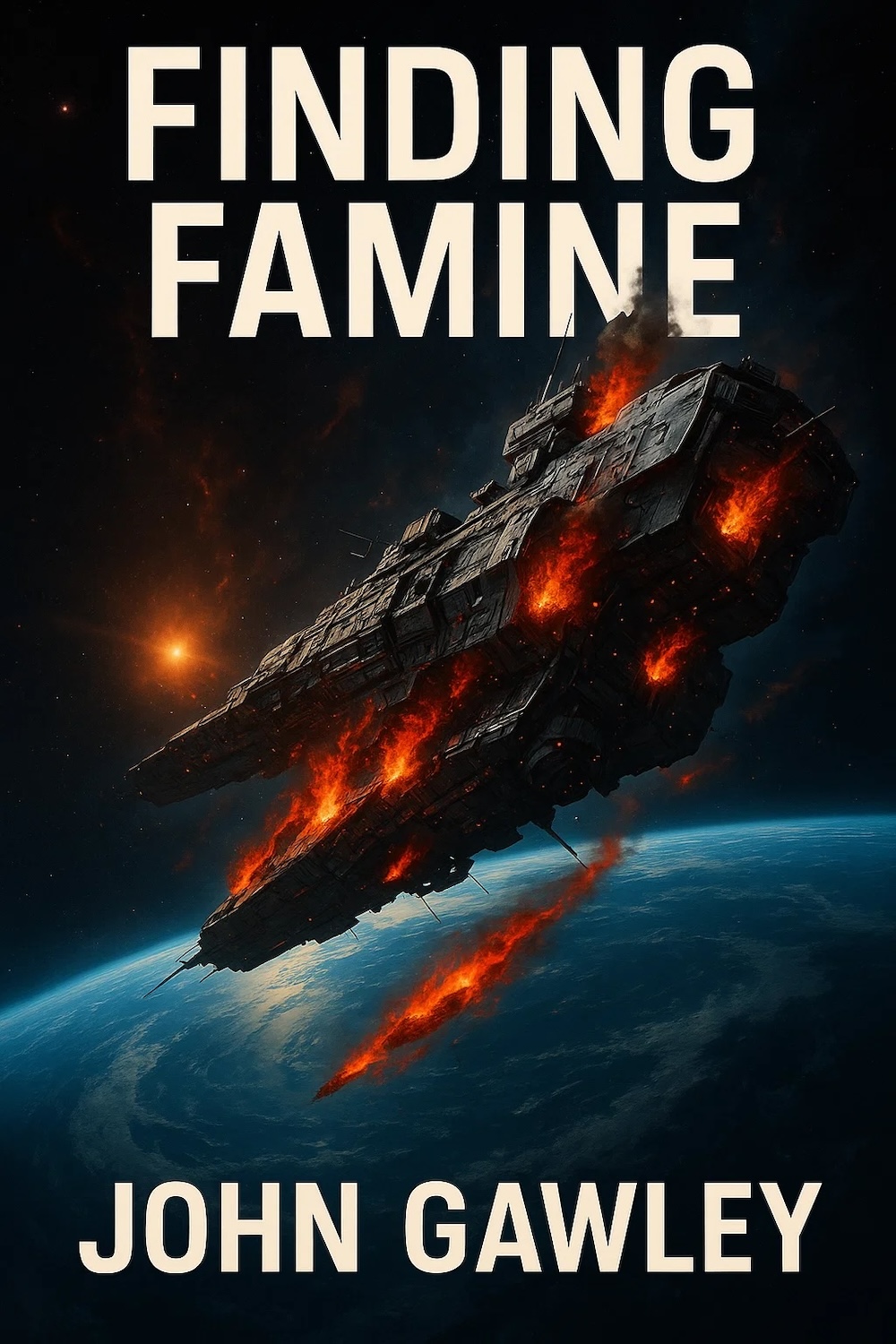
The Doomships have wandered the stars for centuries, their guns silent, until a conspiracy threatens to wipe them out–and half the galaxy with them.
Click to read a sample!

Bess has run away from her home and family to become a pirate, but she can't outrun her past.
Sample coming soon.