Magic City Mayhem
An overworked necromancer struggles to hold back the tide of magical chaos engulfing Miami
Coming June 2026
Click to read a sample!
PROLOGUE
Dawn struck the golden roofs of the acropolis where Arcadia’s gods were stabled. As the sun climbed, the light slanted down the hill to warm the neat hedges and gurgling fountains of the wealthy. Further downhill, below the crumbling wall dividing the upper city from the slums, the sun squeezed between the tenements to illuminate men in floral crowns moving up and down the crooked lanes. The men used clubs wound in ribbon to poke sleepers out of doorways and roust the peddlers arranging their wares on blanket tops. Behind them, women tacked up green and yellow banners along the street, marking out the path of competition.
Horse-racing had fired the passion of Arcadians since the city had consisted of a few thatch cottages perched atop a hill, above the slime and swarming insects of the river. Today, senators and knights acknowledged the long, straight track of the hippodrome as the ultimate course of honor, and each year’s champion was crowned beneath its stands. But for those forced to sell the children they could not feed, there was no hippodrome but the street. The people’s course of honor was the palio.
This was the morning of the year’s first palio, and Gaius Tullius, known as Naso for his prominent aquiline nose–an organ that was said to alert its owner to the scent of opportunity from five hundred miles away–girded himself in a fine white tunic whose two red stripes echoed the fringe of a senator’s robe and descended from the upper city to the slums. Born to an indifferent family, as a young man Naso had scaled the ladder of politics as deftly as an ape swings himself up into a tree, and had been poised to take the highest office in the republic when tragedy had struck him down. Now fifty-six years old, Naso had to comb his white hair carefully to cover its recession, but moderate living habits had kept his waist trim and his eyes clear. His face, lined as it was by grief, was perhaps better suited to politics now than it had been in his prime. He would need the gravitas that grief had lent him, for in Naso’s absence the republic had fallen into the hands of a tyrant.
Gaius Tiberius Gracchus was a popular despot, originally appointed to supreme power in the exigence of civil war. But now the war was over, the grains stores were dry, plague was raging in the streets, and homeless filled the alleys. With only one man in charge, there was only one man to blame. Scenting opportunity in the air, Naso descended the hill to witness the palio, and to be seen watching it.
He was accompanied only by his secretary Tiro, a skinny man with a long fringe of gray hair who stopped often to hitch a wide leather slave’s belt over bony hips. “We should return home, Dominus.” After thirty years, Tiro had not lost the trilled consonants and plunging vowels of his native Cersia.
“Are you afraid of horses?” Naso smiled, but his secretary only looked at him sideways.
“I am afraid of Tiberius.”
Naso’s smile disappeared. He cleared his throat. “We must be brave, my dear. The people will be watching.”
“They will not be the only ones,” Tiro muttered.
Naso was growing tired of his secretary’s fears. His plan depended upon the palio. Ownership of a successful racing team could attract the people to a politician’s cause. But while other senators fielded animals from famous training houses, or else bred their own on vast estates, Naso saw that a horse and jockey who could thread the alleys between the crooked lanes, never breaking stride, could be a prodigy on the racetrack. He lifted a lecturing finger. “The greatest fear of tyrants is that the people might realize their power. What better fillip to their courage than seeing a team from the slums enter the hippodrome and leave the thoroughbreds behind?”
Yet it would not be easy to coax a champion from the people. Palio horses were stabled in apartment courtyards, fed by volunteers who trudged in fodder from the threshing fields. Riders ate and slept and loved their wives behind the same doorways that sheltered spectators in a race. No man’s neighbors would look kindly on a jockey who sold his courage to some faceless senator. And if that senator planned to challenge Tiberius, it would take more than a purse of gold to tip the scales, when weighed against the fear of retribution. Naso went on: “I must show my face, make myself one of the people, and let them see that I love the palio horses as they do. Only then can I win their loyalty.”
Tiro shrugged. “I am sure it will entertain them to see a senator be stepped on.”
Naso sighed. “To rise in this world is an act of will. Perhaps a slave cannot understand.”
As he walked on, Naso felt the back of his neck grow hot. He touched the double-phallus necklace that protected him from the evil eye. But when he turned around, Tiro was innocently watching a tavern owner roll aside his wooden shutters to open for the day.
Morning cart traffic, rumbling downhill to escape the daytime ban on heavy transport within the city walls, forced Naso and Tiro up onto the narrow lip of sidewalk. Naso shook his head. He depended on his secretary to remember names and promises, but Tiro had a way of making mistakes when he felt himself mistreated. Naso took his secretary by the elbow, pitching his voice low. “There are many senators who oppose Tiberius, but they are too afraid to act. If we can win the people away from him, then our friends can stand up to Tiberius at last.”
Tiro sighed. “And so you will stake our lives on the courage of senators.” He shrugged. “There are advantages to dying, I suppose. I will get to see my mother again.”
Naso gave up and released Tiro’s elbow as they entered the long, barrel-vaulted gatehouse of the old city wall. As they descended the dim, sloping tunnel and emerged into sunlight, they passed from a world of marble into one of brick and wood. Over the centuries, Arcadia’s slums had grown from tent cities into brick tenements, whose roofs sprouted makeshift apartments of wood and stucco. Once rooftops were crowded to the eaves, new rooms leaned out on stilts, four and five stories above the lanes. Where two rooms touched above the street, walls were knocked down between them to open flying passageways. Whole quarters burned down in the yearly fires, but apartment blocks sprang back like mushrooms, often at new angles.
Only the Caelian Way cut a straight, unchanging path through the slum, from the old city gate down to the river. Today the Caelian was closed to traffic. Aficionados in green or yellow made luxurious use of its empty lanes, lending a festival taste to the air. Pedestrians clumped together in threes and fours, then larger groups, until the flow of spectators carried Naso and his secretary down a side alley. The race would not follow the long, straight highway. Instead it would thread a rabbit’s course through the slums, riders depending on intimate knowledge of the quarter to navigate a track they had not seen before today.
A hundred yards off the Caelian, Naso and Tiro reached a triangular apartment block. Banners were draped around the sharp prow of the building, indicating that the tight corner, with its miniature plaza, would form a sudden switchback in the race. Naso contemplated the bend. It was far more dangerous than anything the hippodrome had to offer. This is why I am here.
He touched his slave on the shoulder and pointed to the nervous crowd that gathered at the bottom of the V-shaped turn. Buildings of timber and stucco hemmed in the narrow plaza on either side. This was the decisive point to observe riders in a crisis. Naso joined the press that huddled in the lee of an enormous grain barrel.
“Oi, senator!” a voice rang out. The speaker was perched in a second-story window set into the prow of the building. Green ribbon wrapped his calves, beneath the thongs of his sandals. His feet dangled above the heads of a few brave spectators who shunned the protection of the crowd. “Does your banker know you’re here?”
Naso shaded his eyes with one hand: the name MARIUS was tattooed on the heckler’s forearm. A shiver raced down Naso’s back. A barbarian-turned-citizen, an adventurer who had won his fortune at sword point, Marius had once been the people’s favorite and the chief rival of Tiberius. Their bloody contest had eventually driven Marius fleeing into the wilderness, never to be heard from again. Most people thought he was dead.
Faces turned to Naso around the plaza, some expectant, others anxious. Naso called out in stern, court-house voice: “No, he doesn’t. Run and tell him to lend me another ten thousand!”
Their laughter was buoyed by relief: this senator was game. A few brave souls clapped him on the back, and Naso grinned. The heckler was neutered. Naso cast a glance at his secretary. By end of day, Tiro would know the man’s name and reputation and whether he had debts of his own. Next week would see this neighborhood wit campaigning for his new patron, Naso. “Help me up on top of this grain barrel,” Naso told the crowd, “and let me see what these palio horses can do.”
That was enough to inspire a ragged cheer, and Naso was hoisted up, his hands on their shoulders, to stand tall on the lid. His neighbor in the window raised one palm skyward and shrugged in defeat. With his other hand he swung a bladder of wine toward Naso. The senator raised his hands, and the man in the window tossed the sloshing leather bag in a high arc across the brief piazza.
Naso had lived in the country. He hefted the bladder in his right hand and with his left he aimed the nozzle at his open lips. He squeezed, and a jet of hot, sour wine hissed into his mouth. Another cheer went up, and the man in the window was laughing when Naso wiped his chin and tossed the wine back across the way. The crowd began to shove and back-slap, jostling the barrel in their glee. Naso steadied one hand against the closed shutters of the bakery behind him, looking down at his red leather slippers. Something he’d seen in the crowd plucked at his mind. He looked up again and frowned.
Some of the spectators were not moving with the crowd.
Below the windowsill, a tall man with a beard and weathered cheeks was watching Naso. The edge of a tattoo was visible on his throat; the rest of it was hidden beneath his square-cut tunic. Feathers. Probably the wingtip of some bird, diving for prey. Naso had spent his mandatory military service working as a secretary, but he knew a veteran when he saw one.
A distant roar marked the beginning of the race. Across the alley from Naso, a drunk stumbled into the veteran, who turned and shoved him to the ground. Naso saw the leather bracers that protected his arms. As the drunk went down, the veteran’s eyes flicked toward the mouth of the alley. Two more veterans were waiting at the intersection with the Caelian Way, forcing traffic to flow around them.
Naso looked down at the rim of the barrel. The drop was too steep to climb down; he would have to ask the people for help. His secretary had been pushed out of reach.
I am sure I have seen that face before. He glanced back at the man across the alley, trying to place him. Cheers echoed down the lane, and Naso turned with the others toward the sound of thunder.
Horses burst into the sunlight on the far side of the Caelian. They sprinted across the broad avenue with knees high, foaming lips levered open by their bits. They plunged back into shadow as they entered Naso’s alley, their hooves spraying dirt behind them. Two jockeys were far out in front, riding bareback just behind the shoulders of their mounts. Each man whipped his horse on, reins raised high, anticipating the turn.
Naso frowned. A rider who pulled his reins across too early, or dropped his hips to the inside flank, would cause his horse to ‘shoulder,’ dipping sideways against the force of the turn. The effect was dramatic, but the technique was slower than it looked. A disciplined jockey would stay erect throughout the turn, guiding his mount with his knees, painting the prow of the building as he passed.
The lead riders came on side-by-side. As the crowd squeezed together, jostling the barrel, the jockeys turned their whips against each other. The face of the outside rider was streaked with blood. He hunched his shoulders against the blows, and as his rival slowed for the turn he put the whip in his teeth, pulled the reins over in his left hand, and dropped his hips over the horse’s left flank. His right hand gripped the animal’s mane, his right knee hooked over its back.
Naso had made a terrible mistake. The beast began to shoulder, hooves flinging dirt into the crowd as it leaned into the turn. The barrel shuddered beneath Naso’s feet.
The horse’s hindquarters dipped. The back leg splayed out and the great head tossed back, one huge brown eye wreathed in white, looking straight at Naso in dumb terror.
The crowd was screaming, shrill pain in Naso’s ears. They shoved each other, desperate to hide behind the barrel. The world tilted. Naso stretched out his arms. He pitched sideways into the crowd. His grasping hands found a pair of narrow shoulders. Long hair whipped his face. Woman. She shoved him away, her rough palm against his cheek. Naso did not let go. He sensed the huge body of the horse crashing into the crowd just behind him. His knee cracked into the stone step of the bakery and he dragged the woman down.
Hooves beat the earth all around them as the next group of riders took the turn. The crowd was fleeing up the street, leaving Naso exposed. He released the woman and tried to stand. Pain lanced through his kneecap and he fell back, gripping his leg.
The horse lay against the wall of an apartment beside the baker’s, scrabbling to rise. Its hooves slipped and flailed near the head of its jockey, who lay clutching his arm. The man’s eyes were shut against blood that matted his hair and flowed down his face. Grain from the broken barrel was scattered across the dirt expanse of the square. One elbow against the ground, Naso pushed himself closer to the wall.
Someone gripped Naso’s arm, and he leaned heavily on his good leg as he was pulled upright. Naso glimpsed the edge of a tattoo. Feathers. He looked up into the weathered face that had watched him from the crowd. I know him. Where do I know him from? “Where is my secretary?” Naso tried to look around, but his neck spasmed with pain.
“We’ll find him.” The stranger pulled Naso’s arm across his own shoulders, pretending not to notice the senator’s attempts to twist away. “Let’s get you out of the street.”
Naso took a breath to protest, but there was more thunder in the distance. The crowd around them was growing frantic, some of them beating the fallen jockey, who simply hunched his shoulders against their slaps and kicks, still clutching his arm. Naso tried to take a step and cried out.
“Better give me your weight, senator.” Sunlight dazzled Naso’s eyes as they reached the mouth of the alley. “Clear a path, there.” The stranger had an officer’s booming voice, and plebeians pressed each other out of the way as Naso shuffled beneath the green banner that spanned the Caelian between the alleys.
“Let me rest.” Naso tried to lean against the tile counter of a wine bar, one hand still clutching at his knee.
But the stranger kept moving, his grip tight on Naso’s wrist. “These things have a way of turning ugly.”
“I need to wait for my secretary.”
“I see him coming up behind us now.”
Tiro emerged from the alley, looking up and down the street. Naso moved to extract himself from the stranger’s grip, but the street was packed and Tiro disappeared in the crush. Naso had little choice but to let himself be pulled along. His knee ached a little less with each step up the hill.
Outside the gatehouse tunnel, Naso put his hand on the altar of Regius cut into the wall. Old candle wax was hard and cool beneath his fingers, and the black marble god stared down at him with golden eyes. His escort stopped, but did not release him. “I can walk on my own now. I insist.” Naso glanced down the avenue, steepest here beneath the crumbling city wall, and saw Tiro moving quickly up the hill behind them. Atop the gatehouse, a crowd had gathered to watch the chaos below. “Thank you for your help, citizen.”
“My name is Arsenius. And I’ll see you home safely, senator.”
Arsenius. It took Naso a moment more to place him: the captain of the tribune’s bodyguard. There were drawings of the tribune brushed onto staircases and alleys all around the city. They showed Mathis Caelo as a snarling dog, straining against a chain held by his master, Tiberius. In some of those images, the chain was beginning to snap.
“Come along now, senator. You’re almost home.” Arsenius did not look at him as he propelled Naso relentlessly up the street.
Two of Naso’s slaves sat on sidewalk benches outside his home, where his clients would normally assemble in the morning. They did not look surprised to see their master returning with a stranger, and they did not get up.
Arsenius led Naso through his narrow foyer and into the atrium with its potted purple foxgloves and shallow sunken pool. There were no kitchen smells of woodsmoke and cooking oil, no noise of hammers from the workmen who still labored to repair the roof. The tribune’s henchman propelled him by the arm through the damp air of the atrium and into his study. Naso’s heart pounded as his eyes adjusted to the sunlight slanting in from the garden.
In the far corner of the room, Mathis Caelo sat at Naso’s desk, leaning back in his chair with his feet on the table. Rolls of Naso’s private correspondence were scattered in front of him, and the tribune held a letter up to the light of the oil lamp hanging on a brass chain above the desk.
Naso’s eyes fell on a leather sack on the table, still caked with black earth. The bag’s cord was cut, the copper banker’s seal clipped in half. A few coins were scattered on the desk beside the bag. Naso sagged against Arsenius. This is it, then. As of this morning, that bag had still been buried in his garden, along with a dozen others like it.
Mathis had short, wiry hair, more gray than black. One boxer’s ear was permanently swollen and his nose was set at an angle. A seam ran from the edge of his bottom lip to his chin. There was no stiffness in his movements as he took his hobnail boots off the desk and sat up. “You’ve been back in the city less than a year.” Mathis let Naso’s letter roll itself shut and dropped it beside the others. “You should have stayed in retirement.”
Arsenius let Naso go. Naso turned and sagged to the sideboard below the garden window, the furthest place from Mathis. He concentrated on lifting the wine pitcher. “I did not retire.”
“No. I suppose you didn’t.” Mathis paused. “I’m sorry you lost your daughter. I never had the chance to say so in person.”
“I got the animal you sent.” Naso had slit the jugular of the black yearling ram with his own knife. He cleared his throat. “It was quite a gesture.” Black animals were hard to find, and there was no better sacrifice to protect the newly dead.
“I met Tullia once,” said Mathis. “She attended a dinner for that satirist, Quintus Junius. A poet with prize money is irritating company. Tullia got the better of him several times that night. She had a rare combination of dignity and wit.”
“That is kind of you.” After seven years, Naso could answer praise for his daughter with only a slight hitch in his voice. You shook my heart: a wind on the mountain, troubling the oak trees. One of Tullia’s verses, it struck him now like a funeral thought.
Mathis sighed. He reached into the leather bag, and the contents rattled as he seized a fistful of Naso’s money. Mathis made a neat stack of coins on the desk. “You weren’t much of a soldier, Naso, but you were smart. I followed your career with some enthusiasm, after you left the army. It’s not often that a new man rises in this city.” He lifted the topmost coin from the stack. The face of Marius, stamped onto the coin’s obverse, was instantly recognizable by its long jaw and prominent brow. “So conceive my disappointment.” Mathis read the words stamped into the coin’s reverse, curved around an eagle with lightning in its talons. “Righteous, Vigilant, Relentless. The man’s arrogance is breathtaking.”
Naso drank deeply and looked into the garden. He had placed his desk opposite the window, despite the weaker light, so that he could watch Tullia chase her mother around the shrubs and statues. After she was grown and gone he had often stood here at the window, staring. He wanted to remember.
Too late to lie. “I never thought Marius would stamp his own face and motto onto those coins.” In every other respect, the coins were a perfect replica of Arcadian argentii… except that Marius minted silver that was noticeably more pure. I should have melted them down. But a stamped argentius was worth half again as much as the silver it contained. “If Marius thinks that he has purchased my allegiance with them, he will be surprised.”
“I doubt you’ve ever done anything that has surprised Marius,” Mathis said. “He knows you have to spend his money to finance your return to politics. He knows I have informants in your household. This coin is a message,” he rotated the silver disc between forefinger and thumb, “aimed at me.”
“And you think Marius is arrogant?” Naso shook his head.
Mathis set the coin down deliberately, and it clicked against the taut leather covering of the desk. “You took money from a would-be tyrant whose followers once burned this city to the ground. What did he buy from you, Naso?”
Naso swallowed more wine. “You already know.”
Mathis rose and walked slowly around the desk. “Tell me.”
Naso could feel Arsenius in the doorway behind him. There was no other exit. He cleared his throat. “I sold him weapons from the armory.”
It was the first time Naso had said it aloud. The armory had been his purview, early in his career. He still knew the right people. He stared at a crack in the red frescoed wall, near the baseboards in the corner. He had meant to have that repaired. Now it would never happen.
“You sold the arms and armor of our legions to a man who wants to overthrow the state.” Mathis spoke quietly, letting the accusation linger.
The entire world feared Arcadian steel. Only the legion blacksmiths sang the perfect incantation over each blade, while it was submerged in red-hot coals, to invoke the fiery god Sethlans. Only they could draw the power from the coals into the iron, so that a legionnaire’s javelin flexed without breaking, impossible to remove from an enemy shield, and legionnaire’s sword punctured armor like paper, thrusting into an enemy’s vitals. Only once before had these terrible weapons been turned against Arcadians.
“Marius would have descended on us years ago,” said Mathis, “with a horde of his barbarians. But he would look like an invader. He would wield a barbarian’s weapons. Now, with your help, he will look like an Arcadian. He will fight with our weapons. You have reignited civil war.”
Naso cracked his lips. “What do you want from me?”
“You and Marius are the only new men to rise in Arcadia in a hundred years. Ten years ago, you two might have split the city between you. But you always kept your distance from Marius. He bribed the people with the spoils of military victories, but you did things the old-fashioned way, with speeches and important friendships.”
Naso shook his head. “Marius is a savage.”
“He is. And because you stayed away from him, we allowed you to retire in peace after your daughter died. But now, to finance your return to politics, you’ve sold Marius the knife he’ll use to gut our city.”
Naso would not listen to any more. He stood up straight, despite the sweating of his palms. “Someone must save the Republic. Not just from Marius, but from you and your master.” A tribune was meant to check aristocratic power, but Mathis openly served Tiberius.
Mathis stepped too close to Naso. “Tiberius is the only man who can protect Arcadia.” He jabbed at the senator’s chest, and the faint stink of boxing-glove sweat rose from his hands. “What do you think will happen when Marius and his savages march on the city, carrying the swords you gave them? Are you going to fight them off with speeches?”
Naso looked away from the tribune’s gaze. His personal letters lay scattered on the desk. They are convinced that strength of arms is everything. How could anyone look at Naso’s career and think that soldiers were the only kind of power? At his height, Naso had drawn huge crowds to the courts. They came to watch him prosecute the mighty, and they stamped their feet to the rhythm of his phrases. Marius had fought his way from slavery to citizenship, and his legend had won for him the highest office in the land. Tiberius claimed a goddess in his family line, and most of the city believed his claim. Against these men who would be king, Naso was armed only with the law. He licked dry lips. “I could sway the people away from Marius and toward Tiberius. I could do that for you.”
Mathis made a noise in his throat, something between a grunt and a dog’s growl. “I liked you better acting self-righteous.” Mathis raised an arm and beckoned to the doorway. “I will tell you what you will do for me.”
Tiro came into the room, carrying an iron rod and a tooled wooden writing kit. Naso stared at the hairy little man, but his slave would not look up to meet his eyes. No one else had been present on the night they had buried the coins Marius had paid them.
“You are going to grant Tiro his freedom,” said Mathis. “Then you’ll sign your estate in the province over to the people.”
Naso looked up at him. “My wife lives on that land.”
Mathis smiled, and the scar on his chin pulled down his lower lip. “I promise to see to it that Vyria is comfortable.”
For a moment more, Naso stared at the people’s tribune. Invested with the power to veto the senate, and even to enact laws by a vote of the people, the tribune was one of the highest officers of the state. It was his role to defend the common people, not to sell them into slavery under a dictator like Tiberius. We set the wolf to guard our sheep.
Mathis took the iron rod from Tiro. Spiral lines twisted up the shaft, and it was capped with the howling face of Orcus, infernal god of oaths. “Will you sign?” Mathis asked. There was a hint of violence in the way he held the rod.
It’s too late now. Naso cleared his throat. “My daughter’s shrine must be maintained. She must have offerings.” He looked at Mathis until the tribune nodded. Then Naso dipped the brush and gave away the bulk of his wealth in this world.
“Thank you, senator. Tiro?” Mathis lifted the iron rod. “This man before me asserts that by the laws set down by Evander the Arcadian, he is a free man and no slave.” He waited a few heartbeats, then glanced at Naso.
As Tiro’s owner, Naso was required to physically let him go. Drawing in a shaking breath, Naso gripped Tiro by his bony shoulder. “You tutored my daughter. I would have manumitted you myself, once we had freed the state.”
Tiro looked at Naso from beneath wiry gray eyebrows. “We could never have beaten them.”
For a moment, they stood there in silence. Then Naso released his slave’s shoulder, relinquishing his ownership. Mathis touched the rod gently to Tiro’s brow. Arsenius stepped forward with a felt freedman’s cap, and Mathis placed it on Tiro’s bald crown. “I find that you are a free man and a citizen of Arcadia,” the tribune intoned, “with the name of Gaius Tullius Tiro.” In a normal voice he added, “I give you joy of your freedom.”
When Tiro only bobbed his head, Mathis gripped Tiro’s shoulders until the former slave looked up at him. “They teach morality to slaves to settle the yoke across their necks,” Mathis said. He did not release Tiro, but waited for an answer.
Tiro shifted his grip on the wooden scribe’s box. “I have been told that to rise in this world is an act of will.”
Mathis squeezed his shoulders. “Good man.”
Mathis gestured to the desk. “When you’re ready, senator, you will prepare some correspondence. You are going to leave the city for a time and you must make your excuses. We don’t want your friends to worry about you.”
Naso sank into the creaking, cloth-slung chair in front of the desk, where until today his clients had sat. His hand trembled as he renewed the ink and he had to smooth the bristles of the brush down with his fingers.
There were few letters to write. Tiro handed him pages already addressed with the names of senators, boyhood friends, his second wife. Naso composed short, blunt apologies, wondering if his friends would worry for him. He knew that Vyria would not. She would only see the land he took from her. Cornelia would have sensed something was wrong. My first wife would have come looking for me. But Naso had not spoken to Cornelia in years.
Although they were already divorced by then, Cornelia had warned him, when their daughter died, not to drop out of politics. Grief passes, she had told him. But without you to divide them, Tiberius will take the wealthy vote and Marius will take the people’s. Those two will tear the city apart.
She had foreseen Arcadia’s thousand troubles. But she was wrong about his grief.
He finished the note to Vyria and set the brush back on its stand. We will be parted for a long time, I think. I am sorry I could not make you happier.
Mathis left him no privacy. He took his time reading the stack of notes, and Naso saw his eyebrow twitch as he perused the letter to Vyria.
While the tribune read, Naso looked around his study. The red-paneled walls were inset with white frescoes, their highlights picked out in gold leaf. In this favorite panel, Providus the demigod held his father’s scroll open before a group of naked mortals, teaching those savages the secret knowledge of the gods. In the next panel, mortal workmen raised up cities out of marble and gold.
Naso clasped his hands together in his lap to stop them shaking. “What will you do now?”
Mathis tossed the last piece of correspondence to the desk. “Now, senator, I am going to save us.”
Rough hands closed around Naso’s arms and his chair tipped backward as the tribune’s thugs hefted him. Dragged out of his study between his captors, Naso glimpsed the last panel of the story, wherein Providus received the reward for his service to mankind. He lay staked down in the desert beneath the burning sun, his pale limbs stretched toward the four corners of the world. Wolves with golden eyes trotted out of the mountains each morning to feast on the demigods’ naked flesh.
They were his father's pets.
An overworked necromancer struggles to hold back the tide of magical chaos engulfing Miami
Coming June 2026
Click to read a sample!
Democracy teeters on the edge of a cliff. Two men who would be king vie with each other to deliver the final push.
Coming September 2026
Click to read a sample!
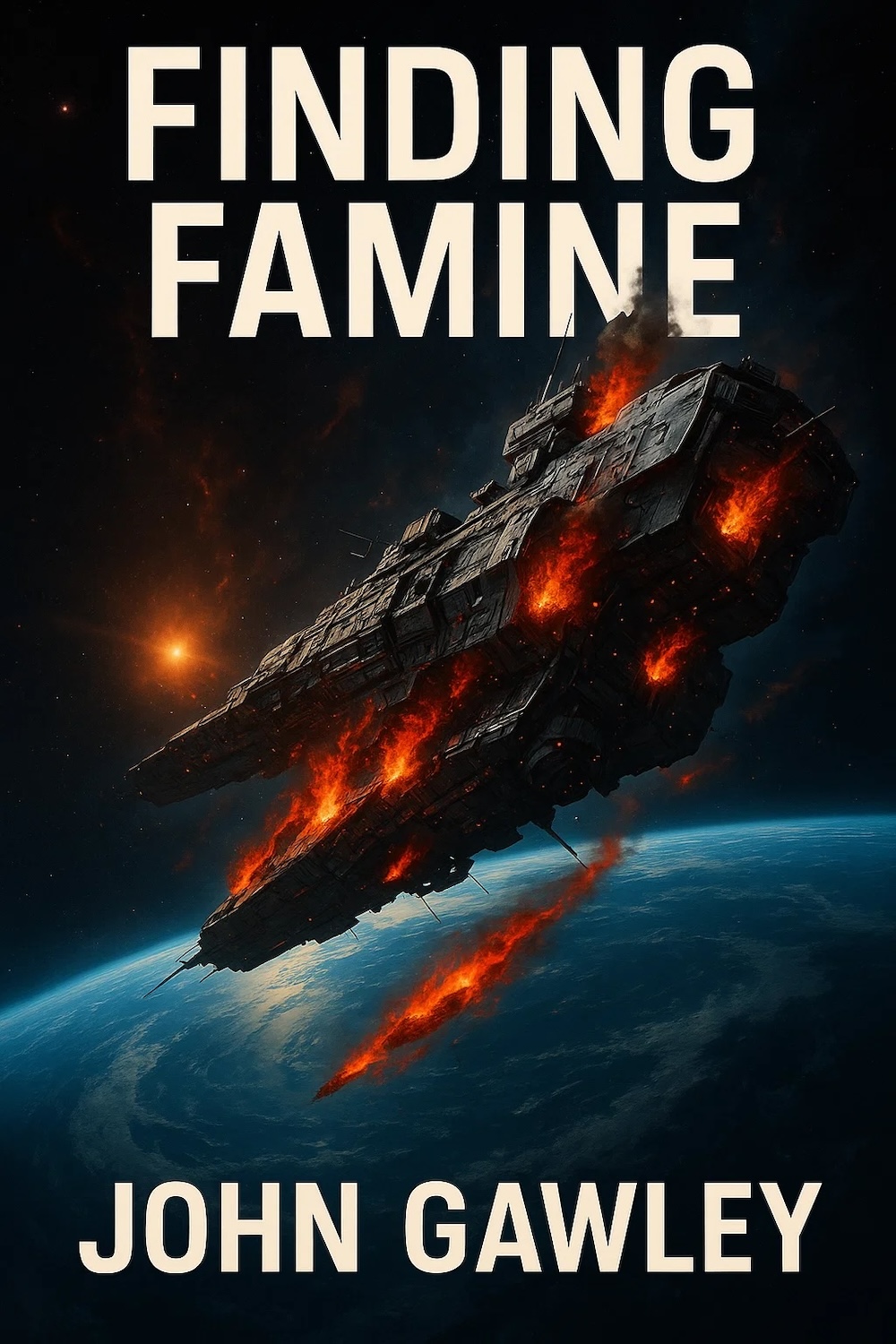
The Doomships have wandered the stars for centuries, their guns silent, until a conspiracy threatens to wipe them out–and half the galaxy with them.
Click to read a sample!
Bess has run away from her home and family to become a pirate, but she can't outrun her past.
Sample coming soon.